In today’s medical landscape, pain management remains a pivotal area of focus for both healthcare professionals and patients. Among the myriad of pain relief options, two opioids—Dilaudid and fentanyl—often come to the forefront of discussions. This article aims to provide a clear, unbiased comparison of these two medications, detailing their uses, mechanisms, and potential side effects. Our goal is to offer an informative resource for those seeking to understand the distinctions and similarities between Dilaudid and fentanyl. Let’s dive into the specifics and shed light on these frequently prescribed pain relievers.
Dilaudid, known generically as hydromorphone, was developed in the early 20th century from morphine derivatives. Its creation aimed to provide comparable effects of morphine with fewer side effects. A few decades later, fentanyl emerged. Originally synthesized by Dr. Paul Janssen in the 1960s, this powerful opioid was introduced under the name Sublimaze. It quickly gained traction in the medical community due to its high potency, making it especially useful for severe pain scenarios in medical procedures. Over the years, both Dilaudid and fentanyl have evolved in their medical applications, but their primary role remains centered on pain relief. By understanding their historical beginnings, we can better appreciate the journey and evolution of these two opioids in modern medicine.
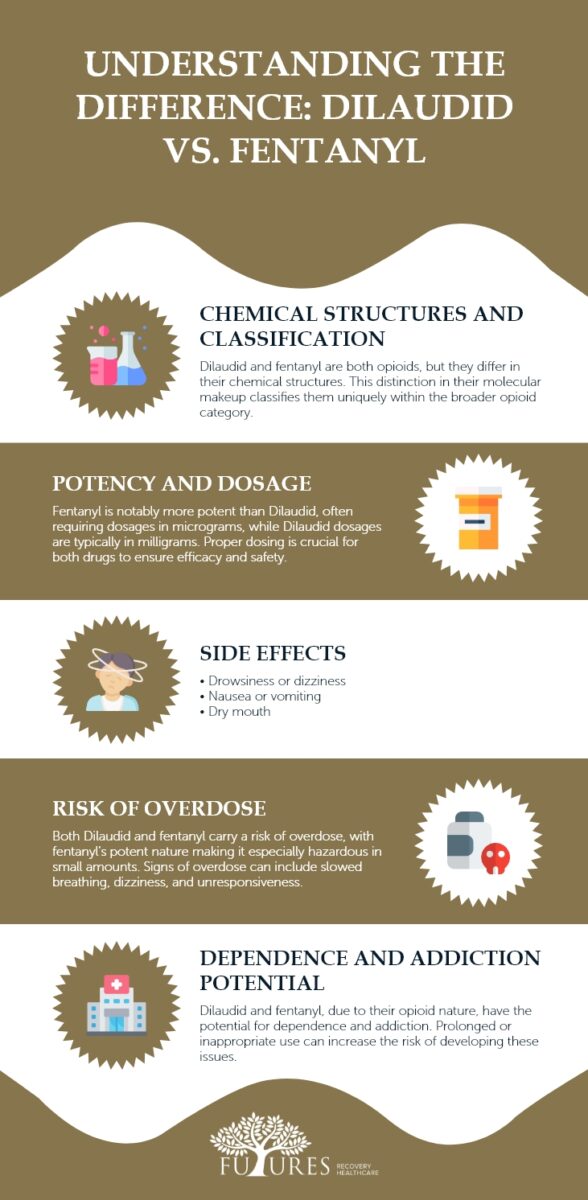
Dilaudid (hydromorphone) and fentanyl are both classified under the opioid category of drugs primarily used in the management of pain. Opioids are derived from the opium poppy plant or synthesized in labs, designed to act on specific receptors in the brain and nervous system. While both drugs share this fundamental classification, their chemical structures differ. Dilaudid, a semi-synthetic opioid, is chemically derived from morphine, making its structure closely related yet distinct in its effects. Fentanyl, on the other hand, is a fully synthetic opioid, meaning it’s entirely lab-created. Its structure is tailored to be incredibly potent, often estimated to be many times stronger than morphine.
Both Dilaudid and fentanyl function by binding to specific receptors in the brain and spinal cord known as opioid receptors. When these drugs bind to these receptors, they reduce pain perception. Essentially, they act as ‘blockers,’ interrupting pain signals from reaching the brain. While the overarching mechanism is shared between the two, there are nuances. Fentanyl, due to its heightened potency, binds to these receptors more quickly and strongly than many other opioids. This rapid and potent binding is what contributes to its powerful pain-relieving effects. Dilaudid, while still effective, has a slightly different binding affinity and duration.
Dilaudid and fentanyl have notable differences in potency. Fentanyl is significantly potent, often regarded as 50 to 100 times stronger than morphine. As a result, fentanyl doses are typically given in micrograms (µg). Its high potency allows for effective pain relief with small amounts, but it also necessitates precise dosing. On the other hand, Dilaudid, while potent, is less so in comparison to fentanyl. It’s about two to eight times stronger than morphine and is dosed in milligrams (mg). When determining doses for either drug, medical professionals assess factors like patient weight, pain intensity, and opioid tolerance. It’s crucial for patients to strictly follow the prescribed amount to minimize the risk of complications or overdose. Understanding their potency and dosing differences is essential for safe administration in medical procedures.
Dilaudid and fentanyl are primarily prescribed for the management of pain. Dilaudid (hydromorphone), a potent opioid agonist, is used to manage moderate-to-severe acute pain and severe chronic pain in patients. It’s used for the short-term relief of severe pain, especially when alternative pain relievers prove ineffective or cannot be used. Dilaudid is often prescribed for post-surgical pain, chronic cancer pain, or injury-related pain. It’s available in various forms, including tablets, liquids, and extended-release oral tablets.
Fentanyl, a powerful synthetic opioid analgesic that is considerably more potent than morphine and Dilaudid, is typically reserved for severe to chronic pain scenarios. It’s particularly useful for patients who have developed a tolerance to other opioids and need a more potent solution. Fentanyl is a common choice in surgical settings due to its rapid onset of action. It’s typically used to treat patients with severe pain, especially after surgery, and for chronic pain caused by cancer. Fentanyl is also sometimes used to treat chronic conditions like severe back pain or neuropathic pain. It’s available in several formulations with different strengths, including transdermal patches, lozenges, and injections.
It’s essential for healthcare providers to evaluate the severity and nature of pain, along with patient history, before deciding on the most appropriate opioid for treatment.
Like all medications, both Dilaudid and fentanyl come with potential side effects.
Common side effects associated with Dilaudid include:
Less common side effects of Dilaudid include dysphoria, agitation, blurred vision, decreased libido, sexual dysfunction, and hypogonadism.
Common side effects associated with fentanyl include:
Less common side effects of fentanyl include abdominal or stomach pain, blurred vision, wheezing, and trembling or shaking of the hands or feet.
It’s crucial to note that individual responses to these medications can vary significantly, and the likelihood and severity of side effects may differ from person to person. Healthcare providers carefully assess each patient’s medical record and individual needs when prescribing and managing opioid medications.
Although the risk of overdose with Dilaudid is considerably lower compared to fentanyl, it’s still a significant concern when using these opioid medications. Overdose can occur when an individual takes a higher dose of opioids than prescribed or combines them with other substances like alcohol or illicit drugs. Opioid overdose is a life-threatening condition, and thus, it’s crucial to recognize the signs of overdose and seek immediate medical attention.
Regardless of the opioid, the signs of an overdose remain relatively consistent. These include:
Recognizing an overdose early and seeking immediate medical attention is vital. Naloxone (Narcan) is a medication that can reverse an opioid overdose and is a lifesaving tool when administered promptly. Always consult with a healthcare provider about the risks of these medications and the appropriate emergency responses.
When using powerful opioids like Dilaudid and fentanyl, adhering to safety protocols is crucial to minimize risks, especially overdose and addiction.
Adhering to these safety protocols and recommendations can help mitigate risks and ensure the beneficial use of Dilaudid and fentanyl in pain management.
Dilaudid and fentanyl are both potent opioid analgesics that have a high potential for abuse, dependence, and addiction. Opioid dependence is a condition that occurs when a person becomes physically dependent on opioids, meaning that their body has adapted to the presence of the drug and requires it to function normally. A person taking prescription Dilaudid or fentanyl as instructed by a healthcare professional can experience dependence, which is characterized by withdrawal symptoms when the drug is stopped.
A person can be dependent on a substance without being addicted, but dependence can significantly increase the risk of addiction. Opioid addiction is a chronic brain disease that causes a person to compulsively seek out drugs, even though they cause severe health consequences. Since Dilaudid has the capacity to produce a high similar to heroin, it possesses a strong potential for abuse and addiction. However, the risk is even higher in fentanyl due to its extreme potency. Given fentanyl’s heightened potency, its misuse can escalate the risk of addiction more rapidly compared to other opioids. This rapid progression makes it especially critical for patients and healthcare providers to monitor for signs of misuse or addiction.
Opioid use disorders can significantly impact lives, but various treatment options are available to help individuals regain control. The primary goal of addiction treatment is to stabilize the individual, prevent complications, and support long-term recovery.
It’s essential to understand that the best treatment approach varies from person to person. Consulting with healthcare professionals or addiction specialists can help determine the most suitable path for an individual’s unique needs.
Setting out on a recovery journey is an act of immense courage and commitment. At Futures Recovery Healthcare, we’re dedicated to walking alongside you during this transformative phase. We offer in-depth care for those navigating opioid use disorders and other related challenges. With a blend of evidence-based methods, our experienced team focuses on a holistic approach, addressing the physical, emotional, and psychological layers of addiction. By understanding the individuality of each journey, we design treatment plans that align closely with each person’s specific objectives and circumstances. With a commitment to ensuring sustainable recovery, we provide not only immediate treatment but also enduring tools and resources for long-term well-being. Reach out to Futures Recovery Healthcare and take that crucial step towards a healthier future.

Our specialized staff stands to ready to help you through this challenging time.
Lorem ipsum dolor sit amet, consectetur adipiscing elit. Praesent tortor tellus, vulputate eu dignissim eu, auctor id justo.

Lorem ipsum dolor sit amet, consectetur adipiscing elit. Nullam placerat, sem a imperdiet gravida, neque nibh lacinia diam, vitae imperdiet ex ex id sem. Lorem ipsum dolor sit amet, consectetur adipiscing elit.
Continue Reading →
Lorem ipsum dolor sit amet, consectetur adipiscing elit. Nullam placerat, sem a imperdiet gravida, neque nibh lacinia diam, vitae imperdiet ex ex id sem. Lorem ipsum dolor sit amet, consectetur adipiscing elit.
Continue Reading →
Sit amet, consectetur adipiscing elit. Nullam placerat, sem a imperdiet gravida, neque nibh lacinia diam, vitae imperdiet ex ex id sem.
Continue Reading →



Payment Portal
Events Calendar
Verify Insurance
Download Brochure
Futures Recovery Healthcare
701 Old Dixie Hwy
Tequesta, FL 33469
Admissions: 866.351.7588
Front Desk: 561.935.5795
© 2026 Futures Recovery Healthcare. All Rights Reserved.


